Category : Knowledge
CYCLONE MONTHA
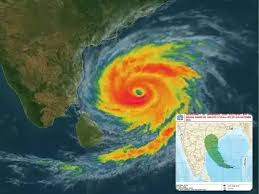
Cyclone Montha is post – monsoon first tropical cyclone over Bay of Bengal region. It is expected to bring heavy rainfall over Odisha, Tamil Nadu, Kerala, Telangana & Andhra Pradesh.
What is a Tropical Cyclone?
A cyclone is characterized by inward spiralling winds that rotate Anticlockwise in Northern Hemisphere and Clockwise in Southern Hemisphere.
Tropical cyclones develop in regions between Tropic of Cancer & Capricorn. These are most devastating storms on the Earth. India often witness tropical cyclones.
Naming of Cyclones –
Montha is named by Thailand
In 2000, a group of nations formed WMO/ESCAP (World Meteorological Organization / United Nations Economic & Social Commission for Asia & Pacific).
WMO/ESCAP comprises of India, Bangladesh, Maldives, Myanmar, Oman, Pakistan, Sri Lanka & Thailand. These countries started naming Cyclones on rotational basis.
In 2018, WMO/ESCAP expanded to add five more countries namely, Iran, Qatar, Saudi Arabia, United Arab Emirates & Yemen.
Why naming a cyclone is important?
With a name, it becomes easier to identify individual cyclones, its intensity and hence awareness can be created and also increase community preparedness.
UPSC PYQ – Tropical cyclones are largely confined to South China sea, Bay of Bengal & Gulf of Mexico. Why? (UPSC 2024)
Practice question – 1. Give the conditions for formation of a tropical cyclone and how it is different from Temperate cyclone?
2. Why Tropical Cyclone is more common in Bay of Bengal?
To find answers of these question lets understand cyclone better
How Tropical Cyclones are formed?
They are formed when Thunderstorm activity start building close to the centre of circulation and the strongest wind & rain are no longer in a band far from centre.. The core turns warm.
The cyclone gets most of its energy from “latent heat” released when warm water gets evaporated and subsequently condenses into liquid form.
Temperate Cyclone on the other hand, forms outside the Tropics. They have cold air at their core & derive their energy from release of potential energy when warm and cold air mass interacts.
Why Bay of Bengal witness more cyclones?
The shape and topography determines the frequency of cyclones.
- Bay of Bengal, due to its funnel shape and complex coastal geometry including Estuary, Deltas, Pocket-like bays, straight coasts, is more prone to cyclones.
- The warmer the ocean temperature, the more intense will be the cyclone. The temperature of Bay of Bengal is generally high.
- Cyclonic disturbances are common in October. Oceanic Disturbances enter Bay of Bengal from South China Sea and head towards Indian Coast.
In a nutshell conditions for formation of tropical cyclone.